
A World-Changing Movement
“For the Son of Man came to seek and to save the lost.” 
Luke 19:10 (NIV)
What a powerful statement. Jesus was solidly focused on his purpose. When the crowd of so called “respectable” people began to talk, well let’s call it what it was, they began to gossip about Jesus. And to be honest, it really was scandalous what Jesus was doing. Jesus had intentionally decided to hang out with that wee little sinner – Zacchaeus. How does Jesus respond to his critics? Well, he clearly articulates his mission – “I came to save those who need saving.” Now, the fact that his mission was so religiously criminal is an indicator of just how far the people of God had drifted from being a world-changing movement.
A few years back, I was listening to a podcast by Jonathan Del Turco. He said that most organizations – and for the sake of this article just insert church here – start out as a movement led by a risk-taker. Over time, the natural drift is for a movement to become a museum, led by a caretaker. If left unchecked, a museum will eventually become a mausoleum, led by an undertaker. I fear that most American churches have subtly and slowly followed this trajectory.
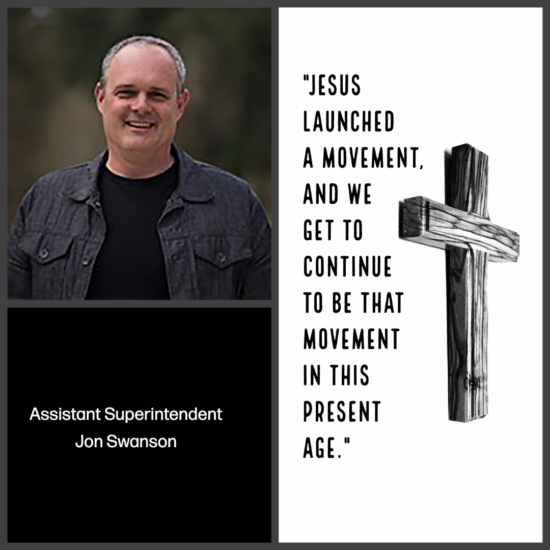
Here’s the main point: Jesus launched a movement, and we get to continue to be that movement in this present age. If you find yourself in an organization that has drifted and you’re wondering if there is an easy solution, the answer is no. I wish there was a simple 3-step process I could share with you to reignite your organization. The reality that many of us are facing is that the farther away our organizations have drifted from being a movement in our communities, the more arduous it will be to shift back. It is hard work. If you are willing to try, let me offer some initial suggestions to get you moving in the right direction. Among other things, make sure what you do is actually aligned with your mission, start taking risks, and evaluate and revaluate everything against the mission. Full disclosure: Embracing the process of relaunching as a movement will cost you donors on the front end and may even cost you friends.
RE-ALIGN WITH YOUR MISSION:
Many churches have a mission statement that goes something like this: We exist to love God and love others. A little vague, but nothing wrong with that statement. The danger with vague mission statements is that we can easily use them to justify preserving and curating the past. Believe me, I am speaking to myself here. It is so easy to get off mission and not even realize it. When that big donor suggests a pet project or that influential member criticizes you for not wearing a suit and tie, it is easy to allow the mission of the movement to be hijacked by the agenda of museum.
How are you doing here? Does your functional ministry agenda, program, and language actually align with your written mission? In my current context, we are committed to reaching the 41% of people in our community who have never stepped foot inside a church. We are passionate about this. We allocate a large amount of money to create environments that clearly present Jesus as the only way to the Father and present biblical truths in a way that people with no religious background can grasp it all the while staying decisively true to the Scriptures. It is entirely possible for your organization to have a really solid mission statement, but to function in a way that doesn’t actually fulfill that mission. Is your church or ministry area aligned with the organization’s mission, or is your mission being hijacked by the need to preserve the past, to keep people happy, or simply, by normal missional drift?
TAKE A RISK:
Jesus took risks all the time, especially when it came to relationships. He risked scrutiny when he hung out with sinners. He risked ‘standing’ with the religious elite when he reframed the commandments to bring clarity to the law. He risked teaching spiritual truths in the form of simple stories called parables so that the Kingdom would be accessible to everyone. He risked being despised by the religious crowd for calling out their hypocrisy and reaching out to the least of those in society.
How are you doing here? Risk-taking may not be your thing, but I’d encourage you to consider stepping out in faith and risking something for the sake of one person far from God. I personally don’t believe that faith can actually exist apart from risk. Perhaps, risk following Jesus’ example to give more grace than you’ve been given. Every movement of God has been led by a risk-taker. Abraham risked leaving his home. Hebrews 11:8 says, “By faith Abraham, when called to go to a place he would later receive as his inheritance, obeyed and went, even though he did not know where he was going.” By faith Moses, chose to be mistreated along with God’s people (Hebrews 11:24-25). By faith the prostitute Rahab,… I’ll just leave you with that much (Hebrews 11:31). Jesus risked the cross, the disciples risked their lives, and the story continues with us. What are you risking?
EVALUATE EVERYTHING:
I like to say that people count, so we count people. Every number represents a person and that person represents a life changed, or not. You’ll never know how you are doing if you refuse to look at the numbers. You’ll never be able to honestly evaluate your organization, your priorities, or your effectiveness if you don’t compare one year to the next. If no one is showing up to an event, then evaluate it, reinvent it, relaunch it, or kill it. If people far from God are not showing up to your services, then evaluate, reinvent, relaunch, or consider honestly embracing a slow painful death.
INVEST IN DONORS:
The primary theme of this month’s newsletter is on growing your church, increasing attendance and increasing income while remaining Christocentric. Like some, I actually believe that all of this can be accomplished. People will give to a movement, but beware, the presence of money, at times, can be an indicator that you are shifting from movement to museum.
Movements typically start with little to no money. The lack of money demands ingenuity, originality, and creative problem solving, which are all essential components of keeping the movement alive. Here are some tips on increasing giving:
- Leaders lead in the area of giving.
- Leaders challenge other leaders to give.
- Leaders teach regularly on biblical generosity.
- Leaders regularly honor normal, everyday people who are exemplary examples of generosity (Barnabas Acts 4).
As we move back into a new type of normal, this is the perfect opportunity to reset your organization. We are not going back to life as normal when we emerge out of the COVID-19 pandemic, so make the most of this moment to kill all the sacred cows that threaten to hijack your mission.
About the Author
Jon Swanson is the assistant superintendent for the Reach Conference and the communications pastor of Timberlake Church in the Seattle area. He previously served churches in Washington and Colorado in a variety of roles that have included lead pastor and worship pastor. He holds a doctorate and a master’s degree from the Robert E. Webber Institute for Worship Studies in Jacksonville, Florida.
God at Work
In my years of pastoring a local church, two topics usually always came up every time we had a pastors’ gathering, they were: people and money. “How’s your attendance?” and “What’s the shape of your budget?” It seemed to me, that these were battle fronts for my fellow ministers. They were fighting the numbers game of people and dollars. And unfortunately, most were losing the battle on one or both fronts.
My experience with these two was mixed. I pastored for seventeen and one-half years. The first five years I pastored a rural church. It was a small congregation with a beautiful building in an idyllic setting. The next twelve years of my ministry, I also pastored a downtown church. The congregation was small, and the church building was very large … voluminous in fact. The country church Sunday service was at nine and the city church service began at ten- thirty.
The dynamics of the two churches were totally different. The city church with a very small aging congregation wanted to return to the glory days of the past complete with the balcony filled and chairs set up in the aisles for the Christmas and Easter services. The people were sweet and willing workers. They were caring and very gracious.
The country church wanted to grow while holding on to all their former traditions and practices. Everything in the church was determined by how it used to be. The congregation numbered about eighteen strong, but they had a significant endowment. So, they continued with their traditions, many of which were endearing and very meaningful to the members. But they did not attract new attendees. I strived not to offend anyone in anyway, as I felt God leading us to move in a somewhat different direction.
I unwaveringly believe that God said what He meant and meant what He said in His Holy Word. Christ is the head of the Church and she is His body. (I always took particular care to never refer to either church, as my church, but as the church I pastor.) He taught that His Word does not return void but accomplishes His intended purpose each and every time it is read, preached, and taught. Therefore, I emphasized the Word. The church still had their dinners and festive occasions, but they were always followed by the teaching of the Word. We had fun at these occasions, but the Word was always preached or taught. I also challenged the congregation to read through the Bible in a year, and many did. 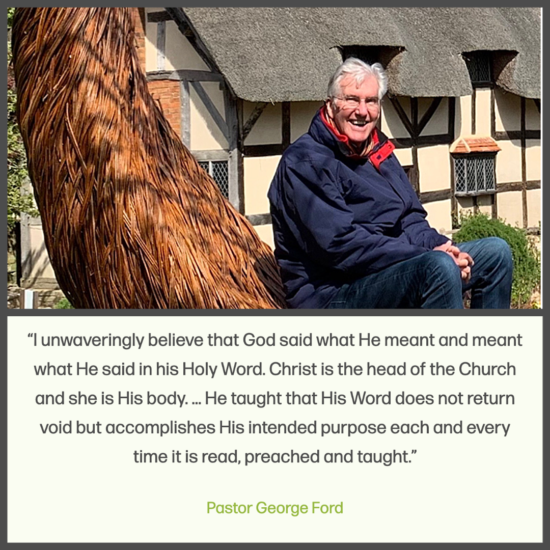
At the city church, a different approach was taken to proclaim the Word. A noon Bible study was instituted every Thursday that was later changed to Tuesday. The format was simple. The ladies of the church, joined occasionally by a man or two, would prepare a delicious meal in the church kitchen. Then a little before noon people would start coming into the basement of the church for the complimentary lunch and Bible study. At twenty past twelve I started teaching … though sometimes I began to preach, so some of the attendees said with smiles on their faces … and thirty minutes later I closed with prayer.
I asked one of the Elders, if they would cover the cost of the meals and they instantly agreed with a generous check to cover the costs of meals for the first year. As one year led into another and another, the checks and meals continued coming. So did the people.
The attendees were an eclectic group. Over the years of the noon Bible study, there were homeless, attorneys, bankers, unchurched, college students, a judge, businessmen and women, retirees, people from other churches, etc. The studies were also diverse, but always out of God’s Word. A week was devoted to each of the twelve disciples, then on to the Gospel of John, Genesis, Acts, Revelation, etc.
I’d love to write: “The noon Bible study increased our morning worship service by over one hundred.” But that would be a blatant falsehood of the first order. We did gain about ten on Sunday morning.
There was another subtle thing happening during the Bible studies. Some of the members of the country church started attending the Bible study. They even started helping prepare the luncheon. So, I began inviting the city members to the dinners and festive occasions at the country church. During Lent I had a weekly Bible study at the country church proceeded by a delicious dinner comprised of comfort foods. The city members came, brought food, and even helped with the clean up afterwards. The two congregations were becoming one through no plan of mine. It was a God thing.
While the city church continued to decline, due to death and aging, the country church was seeing new signs of life. Young couples with children, neighbors, friends and relatives of the members were attending and regularly. More people were involved in the life of the church. The attenders were becoming workers and givers. The congregation of eighteen was steadily growing.
I was passed the normal retirement of ages of sixty-two and sixty-five. My wife and I thought I should step aside while the churches were humming along. I confidentially notified the leadership of both churches the same week that in one and one-half years I would be leaving. This was to give them plenty of time to adjust to my leaving and to prepare for the coming of another pastor.
When I announced this to the leadership of the city church, they immediately voted to close the church when I left. I pleaded with them to reconsider. They did reconsider it four times over the next several months and each time the vote was unanimous to close and unite with the country church.
In light of this, I thought I should step down from the city church after one year and have them unite with the country church six months before I left. Both churches agreed with the idea, so that’s what happened. That gave them the unifying factor of having the same pastor as they transitioned into one church body.
The combined church was healthy in people and money on my last Sunday at the end of my year and one-half. There were eighty people present. The congregation was vibrant and invigorated for the future.
This was entirely God at work. I take no credit whatsoever. I preached and taught His Word. I neither went to church growth conferences nor did I read articles and books on church growth and try to implement programs to enhance the numbers. God did it.
What I strived to do was follow His leading in everything I did. Sure, I made hundreds of house calls and drank lots of coffee with the parishioners. I traveled thousands of miles to make hospital calls both in town and in other cities. I prepared a new sermon and Bible study every week. (I did not preach or teach out of the barrel.) What God laid on my heart is what I did. Sometimes when I arose early on Sunday mornings, God led me to pitch the sermon I had written earlier in the week and write a new one. I never cheapened or watered down the Gospel of Jesus Christ. A phrase I said many times from the pulpit, “Life is short, eternity is forever and ever, please make sure you know Christ as your personal Savior so you’ll spend eternity in heaven.”
I worked hard and spent long hours in the ministry. I received calls in the wee hours of the morning to go to the hospital or counsel someone in need. But I think Saint Augustine had it right: Pray as though everything depended on God; work as though everything depended on you.
I don’t believe God has any easy jobs in the Kingdom. As I think back on the lives and ministries of Noah, Abraham, Joseph, John the Gospel writer, John the Baptist, and the Apostle Paul, I don’t think they had it easy. (I’m not comparing myself to them.) Dietrich Bonhoeffer wrote, “When Christ calls a man, he bids him come and die.”
A Christian brother, who served at the Free Methodist Foundation and has since gone on to be with the Lord, told me on many occasions, “God wants us to wear out and not rust out.” So, I try to obey his admonishment. I pastored a church on an interim basis for over two years in my seventy’s and I’m still preaching, performing marriages, and conducting funerals and memorial services.
Years ago, when my hair was brown and I could jog four miles three times a week every week, I took to heart the words of Jesus, “No one who puts his hand to the plow and looks back is fit for the Kingdom of God.” I’ve tried to obey this caution and still am.
People need pastors, according to the adage, when someone is hatched, matched, and/or needs to be dispatched. While this is true, people need pastors to love them and show them God’s abundant grace. Pastors and congregations need to major in blessing people and not judging or condemning them. Bless means: may the Lord constantly bring good into your life! People need God’s love, acceptance, and encouragement.
Ruth Graham’s gravestone reads: “End of construction. Thank you for your patience.” But until they engrave my headstone, it’s GAME ON!!!
About the Author
George F. Ford is a fourth generation Free Methodist and retired elder.
ADDENDUM:
The coronavirus slipped into our midst as an uninvited guest. She has been very disrupting to our normalcy (ruts). While she may have been unwelcome, she has proved to be a catalyst for change in the present. The change she has wrought upon us and our culture may not be limited to the now but may have long-ranging effects into the unforeseeable future.
To state the obvious, God was not surprised. Nothing catches God napping or unaware. I’m not implying that God sent the virus, but I’m not limiting His ability to do so if He so desired. Everything that happens in the world comes through the loving and permissive hands of God. Also, He could have stopped it dead in its tracks before any harm was done. But He didn’t. Why? Only He knows.
We mere mortals are creatures of habit. Oh sure, we see ourselves as creative, dynamic, and on the cutting-edge people. But are we? Not really. We like and are almost married to our routines. We always buy certain brands, take the same route to where we are going, shop specific stores, drive a particular make of automobile, and prefer the toilet paper to come off the roll from the front or the back of the roll. We may branch out and try something different, but before long we drift back to the old and familiar.
I think the same is true of the church. We’re aware of the different variations of the last seven words of the Church: We’ve never done it that way before. I’ve observed the essence of that phrase expressed in a variety of ways in church meetings and experienced it first-hand lived out in the life of the church. To some this is solemn tradition, but to others this is a familiar rut that leads to the same end.
Maybe, just maybe, God is using the virus to shake the foundation of the Church to get us out of our normalcy (ruts) and approach “church” in different ways. The Word states, “See, I’m doing a new thing! Now it springs up; do you not perceive it?” (IS 43:19). Perhaps He wants His people to do some new things. When we are born again, we become a new creation in Christ and new creatures do new things and do old things in new ways. God is not a static God of the same-ol’-same-ol’. He is active, alive, and dynamic wanting His Church to reach the Silent Generation, Baby Boomers, Generation X, Xennials, Millennials, Generation Z, Generation Alpha, and beyond. I believe that will require change. (I remember the meetings of the WCTU-Woman’s Christian Temperance Union, Cradle Roll, WMS-Woman’s Mission Society, CYC-Christian Youth Crusaders, two-three week every night revival meetings, need I go on? I’ve been around the FMC.)
I titled this article “God at Work.” He has been, is now, and always will be. Praise His Holy Name! (Just remember: When Jesus entered our world, He turned the establishment on its ear. And our world has never been the same. Upheaval can be positive.)
Prayer and Theological Imagination
 Praying well does not guarantee preaching well. Joe might be a prayer warrior, but this does not mean that Joe should have (or that he even wants) the microphone. The opposite is true too. A good preacher is not necessarily a good pray-er. There are probably really smart godless pagans in every town who could stand up and deliver a more powerful, better written (if less sincere) sermon than most of us who preach week in and week out.
Praying and preaching must be interconnected somehow, but we have to start by acknowledging that good prayer is not a sufficient or necessary condition for good preaching. And good preaching is not a fool-proof indicator of good praying. That much is obvious.
This means, by the way, that we should probably abandon the hope of praying our way into being better preachers. God has given us many tried and true methods of improving our thinking and writing and speaking (e.g. read more, take a course, ask for feedback, ask advice from someone who does it better, etc.), it borders on tempting God to ask Him to do the work for us. Praying, and even praying really well, will not activate some kind of spiritual dispensary that will pour wit and style and good exegesis into our heads.
Still, our prayers and our preaching must be interconnected somehow. But how?
There is an old Latin phrase (most Latin phrases are) that runs Lex orandi, lex credendi. Now, not all Latin phrases are venerable and wise (e.g. Quantum materiae materietur marmota monax si marmota monax materiam possit materiari?), but Lex orandi, lex credendi has proven itself useful and true over the 1500 years or so it’s been used in the church. It roughly means: the law of prayer is the law of belief. To put it another way: what and how you pray shapes what you believe. Our prayers shape our theological imagination.
Of course, the reverse is true also – what we believe in part determines how and what we pray. But the church has long recognized that prayer is primary in theological formation. A child who learns from an early age to thank God that he is “not like those sinners” – will likely be a pompous pharisee, even if he hears better theology elsewhere. A child whose diet of prayers consists only of how much God loves me, will likely have an unconsciously narcissistic theology, even if she knows that self-centeredness is wrong. Our prayers, in deep and profound ways, shape what we think about God. Lex orandi, lex credendi.
As preachers, then, our prayers must not become excuses for laziness in preparation (“God, just tell me what I should say”), but we should be learning to pray in ways that expand our theological imaginations – thus inevitably deepening and widening our ability to articulate the nature of our God.
An example: I, like most parents, pray for my children each day. My “go-to” prayer might be something like this: “Dear God, please help my child to have a good day. Keep him safe and help him to find good friends at school. And help him to get over the cough that’s been bothering him. Amen.”
Is there anything wrong with this prayer? No. It is sincere, and I am genuinely concerned about the things I’m praying for. But at the same time, I am training myself, through long practice, that God is around to help everyone generally have
a good time.
Consider, on the other hand, this prayer from the Book of Common Prayer: “Almighty God, heavenly Father, you have blessed us with the joy and care of children: Give us calm strength and patient wisdom as we bring them up, that we may teach them to love whatever is just and true and good, following the example of our Savior Jesus Christ. Amen.”
I genuinely mean this prayer too (and I can “color it in” with specific needs), but it also daily stretches my imagination of who God is, what He is concerned about, and what my role is in relation to Him and my family.
We all tend to have our own favorite three metaphors for God that we lean on. These are mental grooves that we will naturally find our prayers running in – grooves created over a lifetime of praying and singing. These are not bad, but these grooves show up in our preaching too. Our theological imagination has been carved out by our prayers, and our sermons flow from that imagination. To expand our preaching, we need more robust prayers.
If this rings true for you, here are three very unoriginal suggestions to stretch your prayer life (and that of your congregation.)
- Pray the Psalms
Jesus, Mary, Paul, Peter – their theological imaginations were formed by praying the Psalms. This is why the New Testament is a veritable forest of Psalms references. The prayers they prayed and sang from infancy seeped into their theology and songs and teachings and letters. There are all sort of schemas for praying through the Psalms – one-a-day (carve out a good hour for the 119th day), praying through the Psalter over two months, over one month. The monks pray all 150 every week. However you pray through the Psalms you will undoubtedly be struck with how strange some of these prayers are (e.g. curses on enemies), and how very familiar and contemporary some of these very ancient prayers are. But over years, these prayers will shape your assumptions, your longings, your awareness of God. And your preaching.
- Pray prayers that other people wrote
This is confusing for many people. “If someone else wrote it, how can I pray it genuinely?” The truth is that very few of us are truly able to express our own longings, praise, or needs. We simply aren’t articulate enough – especially in the early morning while drinking coffee. All of us have had the experience of reading or hearing something that someone else has written and saying: “That’s just how I feel! I just didn’t know how to say it.” We are not the first ones to pray – let us lean on our brothers and sisters, and learn their prayers, and join their prayers, and thus learn to pray what we couldn’t have prayed on our own.
- Pray prayers from other cultures and traditions
I do not write this from much experience, but from conviction. If prayer shapes belief, and all my prayers come funneled through a Western, Evangelical conduit, then my beliefs – the foundation of my preaching – is coming from a narrow slice of the whole church’s interaction with God. My prayer life, my preaching, and my congregation will be the poorer for it.
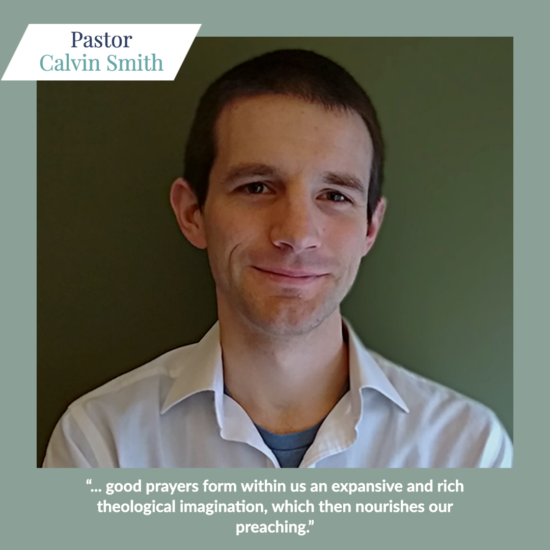
Good prayers do not guarantee good preaching. But good prayers form within us an expansive and rich theological imagination, which then nourishes our preaching.
A good place to end, perhaps, is with a quote from T.S. Eliot, which aptly describes the task of both the pray-er and the preacher, and the daily need to make a “raid on the inarticulate.” We need all the help we can get.
Trying to learn to use words, and every attempt
Is a wholly new start, and a different kind of failure…
…And so each venture
Is a new beginning, a raid on the inarticulate
With shabby equipment always deteriorating
In the general mess of imprecision of feeling
– T.S. Eliot, East Coker
About the Author
Calvin Smith is the pastor of the Belfast Free Methodist Church, and a graduate of Northeastern Seminary. He and his wife Rebekah have been serving the Free Methodist Church in Western New York for 10 years in various roles and churches. When he’s not at the church, Calvin is probably reading with his sons, Silas and Roland, cooking with Rebekah, or outside trying to make something grow.
Knowing the Heart of the Father
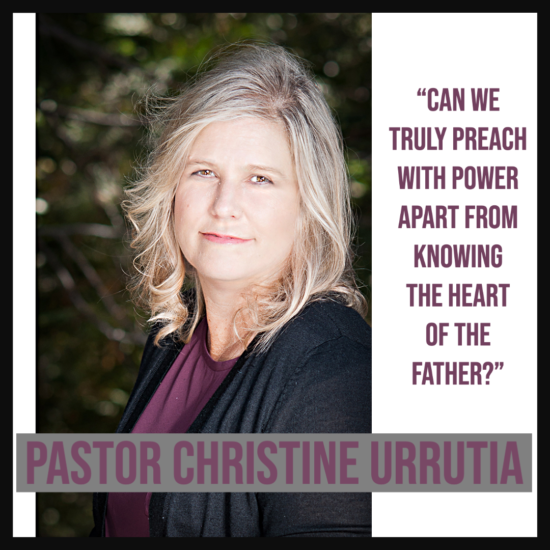
Can we truly preach with power apart from knowing the heart of the Father? I start with a bold question because I believe it’s that important. Wait. Please allow me to correct that: Jesus thought it was that important! John 5:19 says, “Therefore Jesus answered and was saying to them, ‘Truly, truly, I say to you, the Son can do nothing of Himself, unless it is something He sees the Father doing; for whatever the Father does, these things the Son also does in like manner’” (NASB). Jesus, Himself, knew how critically important it was to consistently seek the heart of His Father in prayer. And if Jesus modeled it, then we cannot afford to not be doing it ourselves!
We can preach the Word of God. We can teach the Word of God. We can be really good at both, and God in His sovereignty can bless it, but apart from knowing the heart of the Father, apart from seeking a deep knowing of the Father’s heart as He knows ours, apart from intimately connecting to His heart and seeing through His eyes, we are missing Him! Our preaching needs to be intimately connected to the dunamis power of God, and more importantly His sheep need the invitation to regularly experience the dunamis power of God in their lives also.
That dunamis power is described as a “power, force or ability” and “an excellence of soul” (Thayer’s Greek). Strong’s Concordance defines dunamis as “power through God’s ability!” I love that it is cited in Strong’s as a feminine noun. The key to that power is found in 2 Timothy 1:7, “For God has not given us a spirit of fear, but of power and of love and of a sound mind.” It is the power of the Father, Son, and Holy Spirit given to us that we may preach and teach through God’s ability. I believe that’s one of the many reasons why John 5:19 is in the Scriptures. Apart from God, we can do nothing. But through God, through modeling what Jesus did, we have the ability to preach with power! We have the ability to be the vessel, the conduit, through which God moves to transform the lives of both the saved and the ready to be saved.
Oh Pastor, oh precious men and women of God, if you are already intimately connected to the heart of the Father, then I encourage you to allow the Holy Spirit to fan into greater flame that which your Abba Father has already placed inside of you. Continue the work of the Father as Jesus modeled. Be encouraged that you through God’s ability are making a difference, and the Father sees and loves you! Continue to consistently seek the heart of the Father through prayer and don’t limit Him. And if the many responsibilities of being a pastor or the challenges of being a pastor have begun to crowd that time with the Father, I exhort you to pause, re-focus or re-center and begin anew a holy pursuit of the Father, the Son, and the Holy Spirit through prayer.
What did Jesus do? What He saw the Father doing! Praying pastors preach with the power of God because they are intimately connected to the heart of the Father!
About the Author
Pastor is a passionate pursuer of the Father, Son and Holy Spirit. She loves Jesus! She is a wife, mother, pastor and teacher. She attends Cucamonga Christian Fellowship under the leadership of Superintendent Fraser Venter. She is currently in the Conference Ministerial Candidate process. Most importantly, she is a humble servant of the Lord.
Prayerful Pastors Speak with Power
Pastor Melissa felt fantastic after service last Sunday. As people left church several commented, “Great sermon, pastor!” She knew it, too. She saw tears in eyes. People laughed at all the right times, humor and illustrations were inserted with care to align with the main points. Most important, of course, the Bible was central in the message.
On the other hand, she felt deflated last week. The effort to craft a message, the fruit of her labor, the word for the people given birth through hours of study and meticulous research fell flat. The illustrations did not have the same punch. The “Word of God never goes forth void.” Still, the distress of a “flop” weighed on her shoulders. Thank goodness it went better this week!
Performance is Not Power Preaching
When as pastors we approach preaching the Word of God as a matter of performance rather than prayer, we “flop” regardless of how well the message was received. Teaching the facts of Scripture, paired with a life problem, mixed with a few funny anecdotes, and spoken with proper inflections and hand motions is not “the power of God unto salvation.”
To speak with power – the power of God to burn away selfish dross, purify the stain of sin, replace stone hearts with hearts of flesh, transform relationships savaged by apathy though reconciling love – requires one thing. God. God the Father, God the Son and God the Holy Spirit is not invoked through mental effort and cultural savvy.
“’Woe to me!’ I cried. ‘I am ruined! For I am a man of unclean lips, and I live among a people of unclean lips, and my eyes have seen
the King, the LORD Almighty’” (Isaiah 6:5). Isaiah cried out in the presence of the Holy God his awareness of complete inadequacy. The resurrected Jesus commanded His disciples to wait in Jerusalem until they had received power from on high. Power starts with knowing we do not have real power until it comes from God, of being in the presence of God and utterly undone.
The great Chicago evangelist Dwight Moody learned this from Free Methodist women. After a prayer meeting in which two Free Methodist lay women prayed that Dwight would be filled with the Holy Spirit, the preacher locked himself in a room. He wrote “I can only say that God revealed Himself to me, and I had such an experience of His love that I had to ask Him to stay His hand… I was all this time tugging and carrying water. But now I have a river that carries me.”
Until the river of God’s spirit carries us, we slog through the mud of our limited abilities and self-referential expectations. Good things can still happen, and indeed do. But not the unfettered power of God.
Pray before preaching. Pray during preaching. Pray in preparation to preach. Pray for the move of the Spirit after you preach. But prayer is not a tool we wield in order to achieve our objectives.
Prayer as Life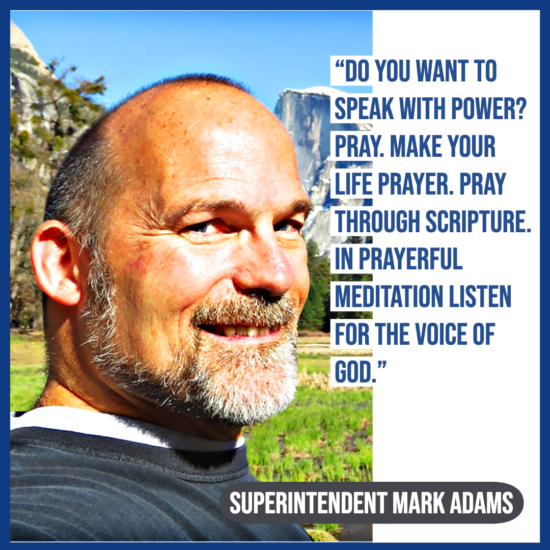
Prayerful pastors cannot merely utter prayers in preparation to preach. After my conversion, I taped to the ceiling above my bed the phrase, “die to self, live for Christ” (based on Galatians 2:20) to serve as my daily mantra. The handwritten note is long gone, but the daily practice of beginning each day seeking God, laying my day before Christ’s Lordship, crying out my need yet for daily forgiveness and renewed power is how the river of the Spirit carries me, even if at times through the shallows.
Prayerful pastors make all of life a matter of crying out in constant desperation for more of God, confident that Abba hears and responds. Knowing we are inadequate but is more than able to use even us liberates the preacher from the “performance” mentality. Prayerful lives are far from perfect lives, but much more likely over time as the daily warmth of God’s love wears away the icy edges of self, to be increasingly like Christ. Ultimately, when the messenger’s life aligns with the message, the impact and power of the message increases exponentially.
Prayer as Listening
Listen for the voice of God. The strong winds of news anchors talking of raging storms echo loudly. The quaking power of great teachers from the past collide with new ideas like tectonic plates and shake each message we prepare. The fire blazing in our church as interpersonal conflicts arise and our desire to bring calm to one side or the other burns hot in our soul. But the still, small voice of the true God is most not in these. And cannot be heard until you are still and quiet before the Lord.
Listen through Scripture, memorizing its contours and allowing its pregnant love and holiness to give birth to the voice of God within. Only then are we able to give voice to that Word in a way that is the power of God for others.
Listen through quiet meditation, waiting for the Lord to speak. God does speak directly to those who turn off streaming devices long enough to be quiet and still. The power, raw and unfiltered, undeniable to the hearer, of experiencing a direct word from God translates into confidence in your shared word with others. To speak powerfully, be quiet.
Prayer as Intercession
Listen to the cries of the people you serve. Powerful preaching does not really start in your study, it starts in the hospital room, grocery store and street corner. Pray with the images in mind of the family broken in divorce, victim of assault, confused woman huddled under the blanket on the corner, the man laid off after 45 years at the factory, the teen arrested being the “wrong” color for the neighborhood, the woman pumped with morphine as she drifts into the last moments of her life. You lift these with cries of intercession before God, sometimes with groans you trust the Spirit to interpret as meaningful because you do not know how to pray and cannot really help them. But God can. As your heart breaks and hopes with the people God calls you to reach, God responds, and will give you a message that has true power for the moment.
Prayer Received
The prayerful pastor also knows that she desperately needs the prayers of others. The Apostle Paul knew he needed others to pray on his behalf. “Strive together with me in your prayers to God on my behalf” (Romans 15:30, ESV). Paul asked people to pray that might find the phrase the gospel well (Ephesians 6:19), for communicate with clarity (Colossians 4:4), see God’s word unleashed (2 Thessalonians 3:1) and many more. This great apostolic communicator demonstrates that not only must we be prayerful, but we very much need the power of the Spirit generated by the prayers of others as we preach the gospel.
The preacher’s power is not in her intellect, charisma, savvy or gravitas. The preacher’s power comes through prayer. Pastors need to know this and recruit a team of saints who will lift them up as they speak, teach and preach as God’s anointed. Prayerless congregations don’t have powerful preachers.
Prayerful Pastors Speak with Power
Do you want to speak with power? Pray. Make your life prayer. Pray through Scripture. In prayerful meditation listen for the voice of God. Let your preaching be reflective of intercession with and for your hurting people. Yearn for and enlist the prayers of others.
As pastors are carried along by the Holy Spirit, what they say transforms lives and communities. Whether it is well received or not, tickles a particular fancy or scratches a certain itch or not, a word from the Lord that has been bathed in the presence of God through prayer will be alive and active, penetrating even to dividing soul and spirit, joints and marrow, cutting through to the very thoughts and attitudes of the heart (Hebrews 4:12). Prayer-infused, biblical preaching is “flop” free! Prayerful pastors speak with power.
About the Author
Mark Adams superintendents the Sierra Pacific Conference (Network of Undeniable Blessing), superintended the North Central Conference and church planted and pastored at several Chicagoland locations. Mark has also worked as a mental health counselor, child welfare worker, social work supervisor and was on faculty at Garret Evangelical Theological Seminary. He is married to Kerrie, and they have four sons and eight grandchildren.
Discerning Difficult Situations
“Oh, the real pastor not here today?” She said it honestly the first time, as I greeted the small gathering for worship before our weekly food pantry opened. As years passed, she begins to say it endearingly with a smile. We both knew she now saw me as someone who served her pastorally, but that first time she saw me fill in for the “Senior Pastor” who was absent that day, she spoke the first thing that came to her mind. As someone who has spent most of my years in pastoral ministry so far supporting a “Senior Pastor,” I’m well aware of the importance of being honest about how we want others to view us.
Let’s face it – we like to appear confident. Many of us who serve as leaders often have people looking toward us on a regular basis, and we find ourselves wanting to be the person they’re looking for us to be. When a question arises, we want to be able to offer the answer. When a problem arises, we want to be able to offer the solution. Even as some of you are reading this, you might be thinking, “Well not me, I’m humble enough to admit when I don’t know, and I can lead people into humility.” We’re so good at this – we can even have confidence in our ability to be humble. We want to be experts in every field, accept any challenge thrown our way, receive any responsibility gladly onto our plate, all with a gracious smile on our face. We live in a world that will celebrate these responses and this behavior and reward it by looking our direction again next time.
But there’s a problem with this: it’s deceitful. It’s deceptive to those we lead and serve, and it’s deceitful to ourselves. It’s perpetuating the same brokenness found in every boardroom and every cubicle in just about every area of the business world. It’s following the pattern set by Adam and Eve in the garden long ago, when they reached to grasp possession of something, they had already been set free from needing to have.
The truth is, we are limited beings. Take a moment and let that sink in, and not in a “false humility” kind of way. You cannot do everything currently on your “To Do” list. You cannot answer every question you will be asked this week. You cannot solve every problem or struggle that comes to you this month. There are some incredibly complex struggles being endured by those you love – and you’ll need to recommend a trusted professional counselor nearby. There are some financial or administrative details you might have misunderstood or made a mistake on, and you need to consult a business professional. This should not be seen as a design flaw in your abilities, or a deficit in an account that should be overflowing.
In John 16, Jesus is preparing his followers for the seasons of ministry to come. He doesn’t paint a rosy picture. He’s honest with them and confesses that some of them will be killed by those who assume they’re serving God. There will be times when people are so focused on being good at religion, church growth, and protecting the empire – they will be blinded to the things of God. But we are not left alone to try and conquer or succeed in such a world. We are promised an advocate, the Holy Spirit, who will guide us into all truth.
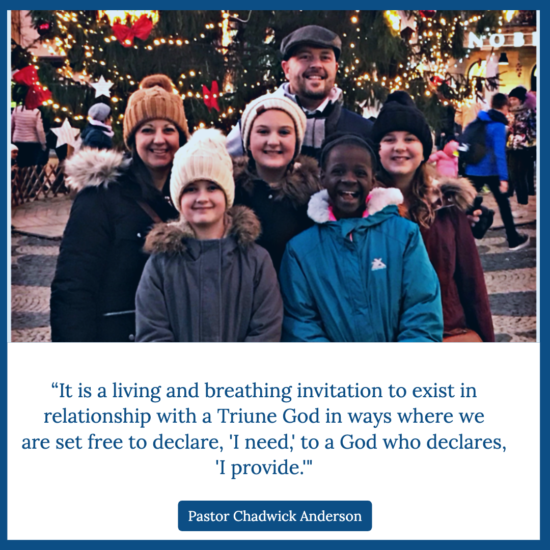
But there’s something interesting about this Spirit, “He will not speak on his own; he will only speak what he hears…” That means even as we receive this from Jesus, it is not to enable us to be increasingly self-sufficient or self-empowered. It is a gift that requires us to be continually reminded of our dependence. It is a living and breathing invitation to exist in relationship with a Triune God in ways where we are set free to declare “I need,” to a God who declares “I provide.” We receive this invitation not as individuals, but also as a humanity for whom Jesus has offered New Creation life.
To put it practically – the struggles you might be facing in your role as pastor and shepherd may often discourage you. There will be moments you look at the brokenness or suffering of a member or family, or the amounts of red in your accounting – and wonder how you could be expected to continue on this path with your head high? In those moments, let me assure you – it’s okay to lower your head. Lower your head in prayer, alongside others who are seeking the will, guidance, and presence of God. Lower your head to look around you – to those who might be more specifically gifted to respond in the particular challenges you face. Lower your head in service, focusing on the feet God has given you to wash. Finally, raise your head in worship – thanking a God who continues to provide abundantly more than all you could ever ask or imagine. You might even find such a response fulfilling your role as pastor more than you ever thought possible.
About the Author
Chadwick Anderson is husband of Sarah & together they are on the adventure of raising four daughters. They serve as FM missionaries in Gyor, Hungary, where Chadwick serves as pastor of a growing English-speaking congregation. Before this season, he has served at Moundford Free Methodist Church in Decatur, IL, for 13 years. He has a B.A. in Youth Ministry from ONU, an MDiv from Wesley Seminary, and usually some fresh roasted coffee beans from Ethiopia. He loves helping others to discover the heart/presence of God in ways that bring transformation and writing or speaking poetry. To learn more about their ministry or connect, check out: www.andersonfamily6.com
What To Do When Facing Difficult Situations
What To Do When Facing Difficult Situations
There is much that I have learned in my nearly ten years of pastoral ministry, but one constant is that difficult situations are to be expected with the calling of being a pastor. They could be something environmental, something within the culture of the church or in the community. They could be due to the pastor doing or not doing something, saying or not saying something. They could come about by some combination of these, or even something else completely. At times, you can see them coming, such as having a board meeting you might be dreading. Other times they might just seemingly appear out of nowhere, like a family getting upset you didn’t visit their mother’s sister’s uncle’s daughter in the hospital when nobody told you they were there. I am fairly certain that I’ve experienced every one of these and maybe a few other situations too. How then do we discern them?
Godly Counsel
The Book of Proverbs gives many pithy sayings concerning wisdom and good, Godly counsel. These are often associated with “life”.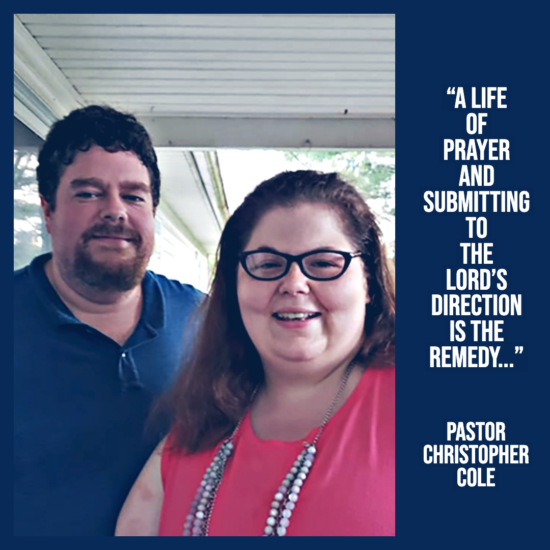
The Book of Psalms also begins with “How blessed is the man who does not walk in the counsel of the wicked, Nor stand in the path of sinners, Nor sit in the seat of scoffers!” (Psalm 1:1 NASB)
Throughout Scripture we are introduced to characters such as King Saul and King Josiah. Saul had initially listened to the counsel of the prophet/priest and former judge over Israel Samuel. However, when he became impatient and decided to perform the duties of a priest rather than wait for Samuel, he was informed that the kingdom God gave him was now given to a man after His heart. Things however went from bad to worse when King Saul spared Agag, king of the Amaleks, despite what Samuel told him. From that time on Samuel and Saul would not speak again.
King Josiah provides another interesting lesson for us. He became the king over Judah at the age of eight. The people he surrounded himself with read like an all-star ballot of Godly counselors: Hilkiah, the high priest who found the scroll of Moses (specifically Deuteronomy) that was hidden away during the reigns of Manasseh and Amon, along with his son Jeremiah, the prophet who warned of the impending destruction of Judah; there was Shaphan the scribe and his son Ahikam; and by Shallum the chamberlain and his wife Huldah, the prophetess. Under Josiah’s rule, not only had the Temple been restored and the book of the Law rediscovered, but a national revival had taken place.
Yet even Josiah succumbed to a selfish desire after having built up Judah’s armies and witnessed the crumbling of the Assyrian Empire. He wanted to reunite what was left of the Kingdom of Israel with Judah under his reign. However, Pharaoh Necho II of Egypt wanted to put an end to the Assyrian Empire and requested safe passage through Judah to do so. Josiah, despite the prophet Jeremiah’s warnings, opposed the pharaoh and was eventually mortally wounded and died.
However, if there is one story in Scripture that places counselors at (or at least near) the center, it’s the story of Job. That is a story that shows us that having others to talk to when going through difficult and trying circumstances is a good thing, it matters who we surround ourselves with. Job’s three “comforters” (Eliphaz the Temanite, Bildad the Shuhite, Zophar the Naamathite) weren’t listening to Job, and had all manner of advice that didn’t help. Yet there is a fourth comforter who comes along (Elihu the Buzite), much younger than the others, who none the less rebukes Job for vindicating himself, as well as the other counselors for giving bad advice. We need people to give us counsel that won’t simply tell us what we want to hear yet speak God’s truth. We also need to put our pride to the side and heed the voice of God when He is speaking.
Prayer
It should go without saying that pastors should be praying. In fact, that should go without saying for anyone who is a Christian. We even learn in Sunday School as kids, “Read your Bible/Pray every day/And you’ll grow … Neglect your Bible/Forget to pray/And you’ll shrink …” How many of us though really take the time to pray through everything?
In Matthew 17:14-21 Jesus is approached by a man whose son is possessed, and there is nothing he can do about it. He even brought his son to Jesus’ disciples hoping they could cast out the demon yet were unable to. So out of desperation the man came to Jesus and explained what was going on. After a few remarks about the unbelief of the disciples, Jesus commanded the demon to come out of the boy, and he was cured.
When the disciples asked later why they were unable to cast out the demon, Jesus revealed that they not only had a lack of faith, but that prayer (and fasting) was required to remove that demon. Interestingly enough, Jesus simply commanded the demon to come out of the boy. He didn’t pray the demon out. Jesus’ life though was a life of prayer. He didn’t simply wait for a difficult situation to go to the Father, He was constantly praying.
As I look at that passage more closely, I sometimes see myself like the disciples. It’s not that I don’t believe or have faith in the Lord and what He is capable of doing, but sometimes I have a bit too much faith in whatever ability I have. A life of prayer and submitting to the Lord’s direction is the remedy for that.
Rely on the Holy Spirit
In the animated adaptation of Pinocchio, Jiminy Cricket serves as the conscience of the marionette brought to life. When Pinocchio doesn’t listen to Jiminy, he ends up putting himself and others in harm’s way.
The Holy Spirit may not be an anthropomorphic grasshopper who wears a top hat, vest and coat, but I wonder if we treat Him as such at times. It’s at this point we need to be reminded He is more than simply our conscience that, if we were to heed, would find that it is easier to navigate difficult circumstances that arise, and perhaps avoid the ones of our own making. The question, I believe, that needs to be asked is, “Do we have a strong enough theology of the Holy Spirit?”
In our country we have stories of self-reliance and determination. We celebrate those who “pulled themselves up by their bootstraps” and made something out of themselves from little. We tend to admire the image (not the product) of “The Marlboro Man”, the tough, no nonsense cowboy/rancher who brings order to wild lands. The Holy Spirit, however, calls us away from that. He makes us fully dependent on God (not that we weren’t already, but certainly makes us aware of that). He gives us the very mind of Christ (1 Corinthians 2:10-12, NASB), which brings discernment into situations that we could not gain on our own.
Not only that, but the Holy Spirit also gives us the power to act as Jesus would. When I was a kid growing up in youth group, the “WWJD” fad hit. I’ll admit (somewhat reluctantly) that I got into it too. It’s not enough to simply ask “What Would Jesus Do?”, but we need to actually do it. Without the Holy Spirit’s activity in our life, and our submission to His activity, we can’t. Although it might at times be difficult to admit we are dependent on the Holy Spirit, that He is more than just a talking cricket with some good advice. He is the very power of Christ in us.
Final Thoughts
I hope that in the above article I have laid out some ways to navigate difficult circumstances. Most of these I have learned from personal experience, and sometimes it took me multiple times to learn. There are just a couple things I want to finish up with, so bear with me.
The first is none of these will keep us from experiencing difficulty. The world is still full of people, and while Christ’s kingdom has been initiated, it hasn’t been culminated yet. We’re also still human, and though we have been set free from the power of sin and have been given the Holy Spirit, there will be times we will make mistakes (though that won’t be our intent). When we deal with other humans there will be difficulty, misunderstanding, hurt feelings, anger, bitterness, resentment, etc. It is my hope that whenever this happens, remembering the advice given above helps you navigate through that.
The second thing is when dealing with difficulty, there are three sides: one person’s (or group’s), the other person’s (or group’s), and somewhere in between is the truth. Sometimes that’s easy to see when we are afforded the luxury of being “objective”, but not always easy if the difficulty is of our own contribution. Either way, we need to demonstrate humility and listen for what God is saying to us in those times, and then applying what He’s saying and leading us to do.
I hope you have found the content above helpful as you navigate your way through difficulty.
About the Author
Christopher Cole, born on December 21, 1983, currently serves as an ordained elder in the New South Conference at Forrest Chapel Free Methodist Church in Westmoreland, Tennessee. He began as a licensed pastor in the Genesis Conference at Brooklyn FMC of East Otto, New York (nowhere near the more famous Brooklyn, NY), and also served Dansville FMC. He has been married to Sandy Buffy Cole since March 21, 2010. Christopher is also a percussionist who plays a little bit of guitar and is trying to learn the mandolin as well. He loves model railroading and writing.
One Indispensible Thing for Avoiding Burnout
 I’m not an expert on avoiding ministry burnout. I’ve been pastoring for twenty-five years, twenty of which have been spent in my current church, and so far I’ve
managed (mostly) to avoid burnout, so maybe my experience lends a little credibility for addressing the subject, but that’s about the extent of my qualifications to write about it.
I’ve heard and read enough about burnout over the years that I could write fairly convincingly, I think, about various techniques and strategies for avoiding it – things like getting exercise, taking vacations, taking a weekly day off, and making time for family, friends, and hobbies. These might be clichés, but they’re clichés for a reason, and having practiced most of them over the years, I can say with some measure of confidence that they really do help.
But I’m not going to write about strategies and techniques for avoiding burnout, for two reasons. First, if you’re in professional ministry, you’re probably already familiar with most of them anyway. And second, while I’m sure that practicing some of them have helped me over the years, the truth is that what’s really kept me going as much as anything is simply grace – God’s grace first and foremost, but also my church’s grace, given in many ways both great and small. And of course, the thing about grace is that you can’t take credit for it.
With that disclaimer, I want to share what has been, for me, the one indispensible thing I’ve learned, not just for avoiding burnout, but for sustaining my life in ministry, period.
Twenty years ago, in the first few months of what is still my current appointment, I was feeling overwhelmed. Up to that point, I had just four years of ministry experience, spending two years each in two excellent FM churches as Associate Pastor. The two Senior Pastors I had served under were great mentors and role models, but I was still young and inexperienced when I accepted my first (and still only) appointment as Senior Pastor – to a church that was still reeling from a recent split.
As I was driving to work one morning, I was praying silently and wondering how I was ever going to survive. I felt pulled in a million directions at once, and in way over my head. There were so many demands on my time and attention, and I had no clue how to prioritize and sort them all out. Just a few months into my first appointment as a lead pastor, and not even five years into my ministry career, I was already feeling the crush of burnout.
The Enemy, seeing that I was on the ropes, probed my soft spots with jabs of doubt: Am I adequate to this task? Am I smart enough or gifted enough? Do I have enough (or any) leadership ability? Will the church respond to me? Am I competent to preach week in and week out? Do I have a compelling vision? Do I have a workable strategy?
In desperation, I started praying. I’d been praying all along, but that morning there was a whole new sense of urgency. It felt like life or death. I could feel the anxiety twisting my gut, the panic rising in my soul. I was on the verge of tears when the Holy Spirit led me to a vineyard. Not literally. I didn’t start drinking, I started reading John’s gospel, chapter 15. The Spirit reminded me of Jesus’s words to His disciples about the Vine and branches.
I’ve always imagined Jesus and the disciples walking past or even through a vineyard as the Lord taught them about their need to “remain” in Him. I picture Jesus pointing to or even standing in a vineyard reaching out to cradle a cluster of grapes while saying: “I am the Vine; you are the branches. If you remain in me and I remain in you, you will bear much fruit; apart from me you can do nothing. If you do not remain in me, you are like a branch that is thrown away and withers; such branches are picked up, thrown into the fire and burned…” Here’s what Jesus taught me in the vineyard…
(1) I’m not the Vine.
I don’t know about anyone else, but I find it easy as a pastor to get a “Vine complex”. Sometimes I start thinking that everything depends on me, that it’s all riding on my shoulders. If I’m not leading to the best of my ability, if I’m not casting a compelling vision, if I’m not coming up with fresh ideas or challenging the congregation or praying enough – or a million other “if’s” – it could all fall apart. That’s a road to burnout.
But Jesus reminds me that there’s only One True Vine in His vineyard, and it’s not me. I’m just another branch. The life of the vineyard doesn’t come from the branches, it comes to and through the branches from the Vine.
My job isn’t to hold everything together – that’s Jesus’s job. My job is to remain in Him. That’s how I can be fruitful. That’s how the church can be fruitful, when we’re all hooked firmly into the Vine together. It’s embarrassingly basic, but sometimes I need to be reminded that Jesus is the Vine and I’m not.
(2) Without the Vine, I’ll dry up.
In a vineyard, if a branch gets cut off from the vine, it dries up in just a couple of days. It goes from green and supple and healthy to brown and brittle and dead. At that point, it’s not good for anything except kindling, as Jesus pointed out.
A branch can’t live apart from the vine because branches aren’t self-sustaining. They need the life-giving sap of the Vine flowing through them. When I fail to remain vitally connected to Jesus and try ministering out of my own strength, I burn through my reserves fast. But Jesus has unlimited reserves. He’s “Living Water”. Drawing on His Life makes my life and ministry sustainable over the long term. Without that, ministry drains the life out of me.
(3) The church needs Jesus’s life flowing through me.
Examine any branch in a vineyard and you’ll see that there are little shoots and leaves attached to it. Those shoots and leaves are dependent on the branch they’re attached to for the life-giving sap that comes from the Vine through that branch. Although it’s obviously an imperfect analogy, the people in my congregation look to me to help nurture their spiritual lives in a similar way. Of course, they need to remain in Jesus just as much as I do, but there is a sense in which my role as their pastor is to provide them with regular spiritual nourishment, too.
The problem is that I don’t have what they need unless the life of Jesus is flowing through me. Not only will I have nothing of lasting value to give them apart from Him, the reality is that people will continue to try and draw life out of me whether I’m attached to the Vine or not! People want their pastor’s time and attention and spiritual resources, and if they can’t draw life from the Vine through you, they’ll just drain your own limited reserves.
That morning twenty years ago I was reminded that the one truly necessary, constant, indispensible, cannot-do-without thing is to stay connected to Jesus, to remain in the Vine. Without that, all the gifts and graces, all the vision and charisma, all the wisdom and skill in the world won’t matter.
I learned early on that in myself I have nothing of lasting value to give to the church, nothing that will sustain a congregation – not my personality, my intelligence, my vision, or my gifts. The only thing I have worth giving them comes out of my connection with Jesus. Everything else is like cotton candy to a starving man.
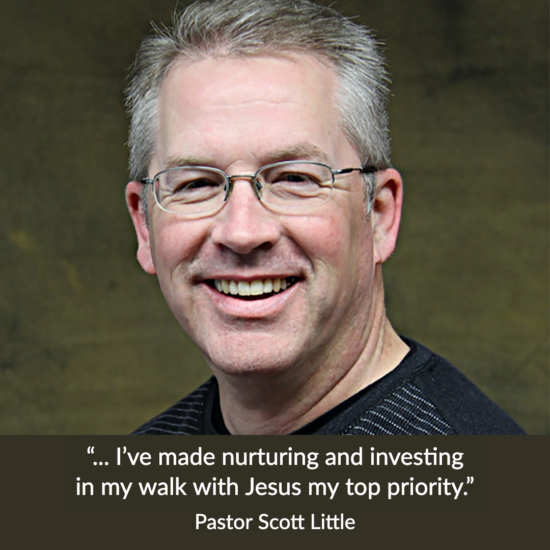
So I’ve made nurturing and investing in my walk with Jesus my top priority. I believe Him when He says that without Him I can do nothing. It takes an investment of time and energy to stay connected with Jesus. It takes discipline and intentionality, too. It’s amazing and frightening that working for Jesus can be part of what keeps us from being with Jesus. At least that’s true for me, so I have to tenaciously guard and purposely pursue that connection regularly, because like Jesus’s friend Martha in Luke 10, I can be distracted by many things, but really “there is only one thing needed”.
Because Jesus deals with each of us personally, I can’t offer any kind of formula or technique to help someone else “remain” in Him. For me, a few of the classic spiritual disciplines like prayer and study and solitude are essential, and I regularly feast on the spiritual wisdom of favorite spiritual writers, but that’s just what helps me. I think that staying close to Jesus is the kind of thing that isn’t one-size-fits-all. But I know when I’m investing in my relationship with Him and when I’m not. I’m guessing that’s true for others, too, so my challenge and encouragement to anyone reading this can be summed up with two simple questions: (1) Are you abiding in Him?; and (2) If not, what do you need to do to change that?
To this day, whenever I feel overwhelmed by the demands of life or ministry, whenever I detect signs of impending burnout, I go back to the vineyard with Jesus. That’s about all I know about avoiding burnout – but it’s always been enough.
Burnout does not have to be part of your Story
As I sat at the table having my coffee that Monday morning, I felt exhausted. I had no motivation for the day, I was emotionally depleted, and I felt like I just wanted to stay in ‘my cave’ and not talk to another person. What was wrong with me?
The Sunday before had been a success by all accounts. The message at church was powerful, the worship engaging, and the people had responded with steps of life change. The Lord had moved in many, including me, through the encouragement through the day of worship and fellowship with God’s people.
There is an axiom among pastors that says, “don’t quit on Mondays.” With all the highs and lows of working with people, it is a well-known occupational hazard how commonplace spiritual warfare is against fulfilling God’s calling as a pastor. Because of this, burnout is the greatest challenge facing pastors today. Left unchecked, the symptoms grow and become unmanageable. Even as pastors, we will find ways of escapisms and medications to avoid the discomfort of our depletion, pain, or disappointment. Burnout is a result of the progressive compromises we make around the boundaries of self-care.
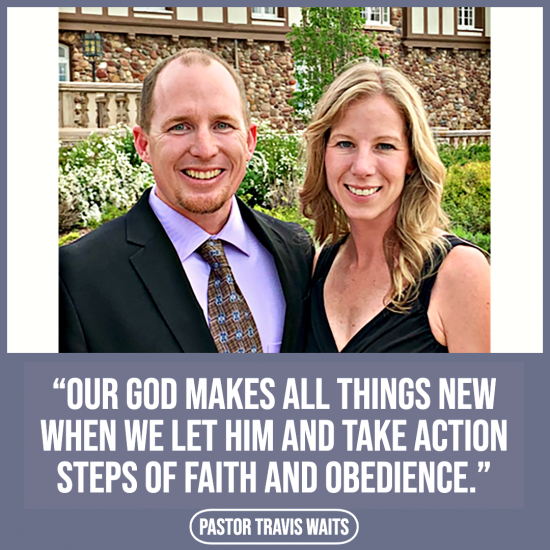
Having lived through my own burnout, I have experienced the process of God resurrecting life from the shipwreck of the consequences I created. Because of my journey of restoration to pastoral ministry, I am confident there are ways to help one another in ministry avoid burnout. Our God makes all things new – when we let Him – and take action steps of faith and obedience.
“The law of the Lord is perfect, refreshing the soul. The statutes of the Lord are trustworthy, making wise the simple.” Psalm 19:7
The steps I will share here are not new. In fact, I “knew them” before my burnout, but did not practice them consistently. If you have the title ‘Pastor’ you know what I’m going to say, and you’ve likely preached these same principles in your own messages in your church. However, the same calling and passion that got you into ministry – to help people – does not always translate into your habits of taking care of yourself.
We cannot give what we don’t possess, and my friend – we must be instillers of hope, and dispensers of grace – not just to our people, but also to ourselves.
1. Gratitude as a Spiritual Discipline
It is easy to talk about our gratefulness for the gift of grace and our salvation. It is harder to raise our eyes to see the small things we are grateful for when feelings of discouragement, doubt, anxiety, depression, or shame show up.
I learned that gratitude is the antidote for these negative emotions because it resets my heart and mind to a proper perspective. The sun does rise, even on the hardest days. Trusting God above our circumstances is possible but cannot be done alone. Gratitude is a learned attitude, and a spiritual discipline.
“I lift up my eyes to the mountains— where does my help come from?
My help comes from the Lord, the Maker of heaven and earth” Ps. 121:1,2
There were many mornings I struggled to write even three things on a sticky note for my morning gratitude list. I let my circumstances dictate my emotions and perspective. Slowly, as I made my list more and more mornings in a row, God used this to change my perspective. I was able to feel contentment and joy return — even though my outward circumstances had not changed.
We know that God is always with us, and the truth is that He never leaves us. But more importantly, dear pastor, God is FOR YOU regardless of the darkness you feel.
2. Boundaries as Practical Self-Care
We all know there is a physical link between emotional health and mental stability. God wired us this way so that we would take action and not just try to think our way out of things. Knowing the right answer is not the solution, nor the prevention. Our actions matter. Emotions are meant to be indicators, not the dictators of our needs driving our behavior. The Apostle Paul writes:
24 Do you not know that in a race all the runners run, but only one gets the prize? Run in such a way as to get the prize. 25 Everyone who competes in the games goes into strict training. They do it to get a crown that will not last, but we do it to get a crown that will last forever. 26 Therefore I do not run like someone running aimlessly; I do not fight like a boxer beating the air. 27 No, I strike a blow to my body and make it my slave so that after I have preached to others, I myself will not be disqualified for the prize. (1 Cor. 9:24-27)
Healthy choices have a reciprocal relationship with healthy boundaries. If we allow the basics of self-care to slip out of our habits and routine, we open ourselves up to the potential to compromise our character in ways that we would never consider had we not been depleted. Without a proper diet, enough sleep, and consistent exercise our minds and bodies do not function properly. These are the foundational principles of self-care.
Because of this, I am intentional to keep my boundaries around healthy choices, and activities that are life-giving for me. In fact, I put them on my calendar because what gets prioritized in my time is what gets done. Here are just a few things I’ve found helpful:
- I go to the gym 4-5 times per week. Sometimes it’s to lift weights because that is something I enjoy. Other times it’s just to walk on the treadmill or use the elliptical. I always have my headphones with my favorite music — it often becomes “my God time” and resets my soul for the day.
- I have found hobbies that compete for my attention. I love to golf, even though I am not very good. Being out in nature, focusing on the little white ball, all help me relax and adjust my perspective. Have fun!
- I prioritize my God time. Sometimes it’s to journal, read His word, memorize a passage, or listen to music that helps me feel encouraged and worship God. It is consistently inconsistent — meaning I don’t put it in a box of how it “should” look.
I also schedule on my calendar to prioritize quality time with my wife, separate from family time with our kids. Regarding the work week of ministry, I target two days off per week and include at least 24 hours not doing anything “work” related. I schedule my email so that I block out time in my weekly calendar that I will respond to emails. I don’t have email notifications on my phone, and I’ve made it a habit to not respond to emails through my phone.
3. Participating in Redemptive Community.
We are only as sick as our secrets. Many pastors are lonely and choose not to develop consistent friendships. If you are the only one who knows your struggle with the symptoms of burnout – then you are in trouble.
In the past, I was not good at asking for help. In fact, I thought I didn’t need my friends to help, so I would isolate and try to handle life by myself. That did not work and God does not want us to go through life on our own – He intends for us to do life with one another. The only way I was able to make it back from burnout was because of some faithful friends who loved me just as much on my worst days, as they did on my best days.
As pastors, our job, and our calling in the ministry is to help people. We must help ourselves first, before anyone else. This is the pre-flight airline takeoff principle: put your own oxygen mask on first, then help your neighbor. Our Lord gave us the same (and the second greatest) commandment when he said, “Love your neighbor as yourself” (Matt 22:39). How we love ourselves is the standard to which we will love others.
We are only as accountable as we choose to be. Healthy accountability is where we are accountable FOR one another, not TO one another. Healthy accountability means we “bear one another’s burdens,…” (Gal. 6:2). It is through these types of relationships based on transparency, honesty, vulnerability, and authenticity — especially on the hard days, that help us avoid the shipwreck of burnout. I have learned the courage to be vulnerable is a skill that can be developed the more we live in authenticity.
James 5:16 says “confess your sins to each other and pray for each other so that you may be healed. The prayer of a righteous person is powerful and effective.”
1 John 1:9 says that “If we confess our sins, he is faithful and just and will forgive us our sins and purify us from all unrighteousness.”
The truth is, we cannot wear-out God’s forgiveness in our lives. I first heard these two passages coupled together from a pastor friend of mine — speaking about his own recovery from burnout. They have since become tattoos on my soul. Through confession, we get hope and empathy. Empathy – because we see we are not the only person who struggles to live a human life. Hope – because God does heal, forgive, and purify us to have a new life.
Next Steps
My intention in writing this to fellow pastors is to save them some pain. Often our pain becomes our platform and our scars tell the story of God’s faithfulness. I pray that these words have been encouraging and helpful. The next step for you to take is one of action. God takes great pleasure in us, His kids. Burnout does not have to be part of your story. Listen to what God is prompting you to do next, and take action from there. What’s the one thing you are going to do different today toward that goal?
Blessings,
Travis
Bio:
Travis Waits has led in pastoral ministry for over 20 years and holds a Masters Degree from George Fox University. Travis serves as the Operations Pastor for Journey Church in Castle Rock, CO providing organizational development, strategy and systems leadership to pursue the church’s vision. Travis and his wife Jaime met at Multnomah Bible College and have been married for over 21 years. They have three kids ages 20, 18, 15 and enjoy many outdoor activities, including learning to golf.
Understanding and avoiding Pastoral Burnout
Introduction
Charles Spurgeon, one of the greatest preachers in his time (1834-1892), had a lifetime battle with depression. At times, he was in bed and immobile. H.A. Baldwin, a Free Methodist pastor/author, early 1900s, wrote Holiness and the Human Element. This book addressed such human frailties and infirmities as discouragement, feelings, nerves, fear and worry. Depression, infirmities are not sinful, nor is burnout.
The Condition
Herbert J. Freudenberger, psychoanalyst, invented the term burnout to describe his own experiences. His definition: “A Burnout is someone in a state of fatigue or frustration brought about by devotion to a cause, way of life, or relationship that failed to produce the expected reward.” (Excerpt from Watch Out for Burnout: A Look at its Signs, Prevention and Cure written by Donald E. Demaray p. 13). Summarizing Archibald Hart’s description, burnout is an emotional response. The victim becomes demoralized, begins to lose vision, loses hope, and is in a crushing state of discouragement and also despair. (Pastors at Greater Risk, written by H.B. London, Jr., and Neil B. Wiseman, p. 178).
The Causes
Burnout has many: exhaustion, acute fatigue, stress, depression, indecisiveness, inability to focus, poor relationship with spouse/family, unstructured personal life, self-reliance. (Leading on Empty: Refilling Your Tank and Renewing Your Passion written by Wayne Cordeiro, 2009).
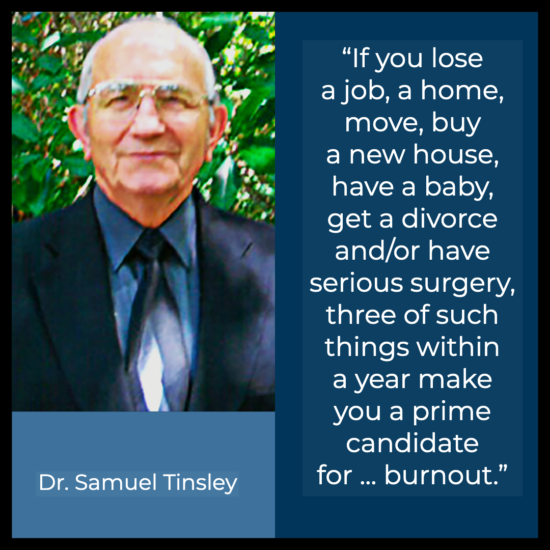
Extraordinary events in life may well trigger burnout. Consider prophet Elijah (James 5:17, 18, 1 Kings 16:33ff). After all the miraculous working of God, he got his eyes off God and on people. Jezebel threatened to kill him. He fled in fear and ultimately collapsed. “Lord, take my life!” I came across this awhile back. If you lose a job, a home, move, buy a new house, have a baby, get a divorce, have serious surgery, three of such things within a year makes you a prime candidate for a nervous breakdown or, I add, burnout.
The Caution Lights
Research reveals the average pastoral ministry life is 5 to 10 years. “90% of pastors may consider leaving the ministry. Pastors most often work more than 46 hours a week.” (Excerpt from Pastors at Greater Risk written by Jack London Jr., and Neil B. Wiseman, p. 22). This may have a negative effect on both pastor and family. Many pastors felt their training was inadequate to meet ministry demands. This causes a pastor to develop poor self-image. The above may lead to warning signs: loss of enthusiasm, feeling alone, hating to answer the phone, focusing on petty things, paying less attention to spouse and family, stress and more difficulty being with people. Bill Mills and Craig Parro noted the outline to burnout includes, “when life seems meaningless,” and “when ministry overwhelms you.” (Excerpt from Finished Well in Life and Ministry: God’s Protection from Burnout, pp. 153, 173).
The Conquerer
“In all these things we are more than conquerors through Him that ‘Loves’ us” (Romans 8:37). These principles in a pastor’s life will insure you against burnout.
Keep Healthy
- Physically – A proper diet and exercise are essential. Your body is the temple of the Holy Spirit.
- Mentally – Positive attitudes and wholesome thoughts must characterize your mind. “Whatever is … think on these things!” (Philippians 4:8). Meditate on the Word of God (Psalm 1).
- Spiritually – “Rejoice ever more. Pray without ceasing. In everything give thanks for this is the will of God in Christ Jesus concerning you” (1 Thessalonians 5:16-18). John Wesley describes this as Christian Perfection. He also declared that “I have so much to do that I spend several hours in prayer before I am able to do it.”
A strong marriage and supportive spouse are irreplaceable. Late Bishop Dale Cryderman advised placing on the calendar your date with your spouse. You have an appointment. Keep it!
Proper rest is essential. This not only means sleep. Jesus told his busy disciples, “come apart and rest for a while” (Mark 6:31). If you do not find a place to come apart periodically you will ‘come apart’. Best of all, wherever you are “there remains a rest for the people of God” Hebrews 4:9).
Delegate wisely. Develop leaders by modeling and training them.
Seize your time. “Unseized time flows toward my weaknesses” (Ordering Your Private World, written by Gordon MacDonald, p. 74). Do not surrender to the tyranny of the urgent. Follow the 80-20 rule. Spend only 20% of your available time with negative, complaining people or circumstances. Spend 80% of your time developing willing disciples/leaders.
The Cure
If you are already experiencing burnout … recovery is possible!
Intentionally review every principle of the previous segment, “The Conqueror,” and immediately begin perusing them.
Determine the answer to these questions. Write the answers down.
- What is your true assessment of your present condition?
- What have been the anchors in your life?
- What are the top priorities of your life?
- What awareness do you have of the power of the Holy Spirit in your life? Francis Chan, in Forgotten God: Reversing Our Tragic Neglect of the Holy Spirit, decries the tragic neglected of the Holy Spirit (p. 15).
- Exercise utter dependence on the Holy Spirt filling and empowering you (Acts 1;8).
- Limit television and technology usage.
- Develop margin. “Marginless is not having the time to read the book you’re reading on stress; margin is having time to read it twice.” (Excerpt from Margin: Restoring Emotional, Physical, Financial, and Time Reserves to Overloaded Lives, written by Richard A. Swenson, MD., p. 13). He writes on restoring calm and sanity to your life.
- Exercise faith for God’s will and total provision in your life.
Three major sources to assist recovery will likely include a Christian counselor, focused prayer support by a support group, and a medical doctor’s assessment to determine if medication is needed.
Continued Recovery
- Find a trustworthy accountability partner.
- Mentor freely: superiors, peers, juniors.
- Review your call to ministry and remember Esther 4:14c.
- Continue to renew that love for your ministry.
- Redevelop a healthy self-image and rid yourself of any victimization.
- Learn to grow in adversity, Philippians 4:11b.
- Keep a sense of humor. God laughs and so can you!
- Be alert to any signs of reversal.
- Improve your ministry skills.
- Ever practice personal holiness.
- Always, in every situation, circumstance, remember that people matter to God, therefore they must truly matter to you. Our motto is, “Love God, Love People, Make Disciples.” Amen.
About the Author
Samuel H. Tinsley was born on November 21, 1940, to James Edward and Virginia Louise Tinsley, in Warren County, Bowling, Kentucky on a tenant farm. James Edward was a Free Methodist pastor and church planter in the Kentucky-Tennessee Conference. Samuel H. Tinsley married Lillian, daughter of Elmer and Alverta Reagle, Free Methodist pastor in the Keystone Conference.
Dr. Tinsley graduated from Oakdale Christian Academy, attended Kentucky Mountain Bible College for one year; attended Trevecca Nazarene College for one year; graduated WKU with a B.A. and M.A.; graduated from Asbury Theological Seminary with a M. DIV.; graduated Union Theological Seminary with a D. Min.
His work experience includes teaching public school from K-12. He is presently teaching Theology by extension for those pursuing ordination. He has served in five different conferences of the Free Methodist Church. He has also served on the denominational Board of Administration for a total of 10 years. He has pastored for 22 years and was a Superintendent in the Louisiana, Pittsburgh and North Michigan Conferences for a total of 23 years. He is now retired in the Gulf Coast Conference (formerly the Louisiana Conference), serving as a district leader.